What Explains the Shrinking Gender Gap in Internationalism?
Nina Obermeier
King’s College London
King’s College London
Gender Gap in Internationalism Over Time
Support for European integration
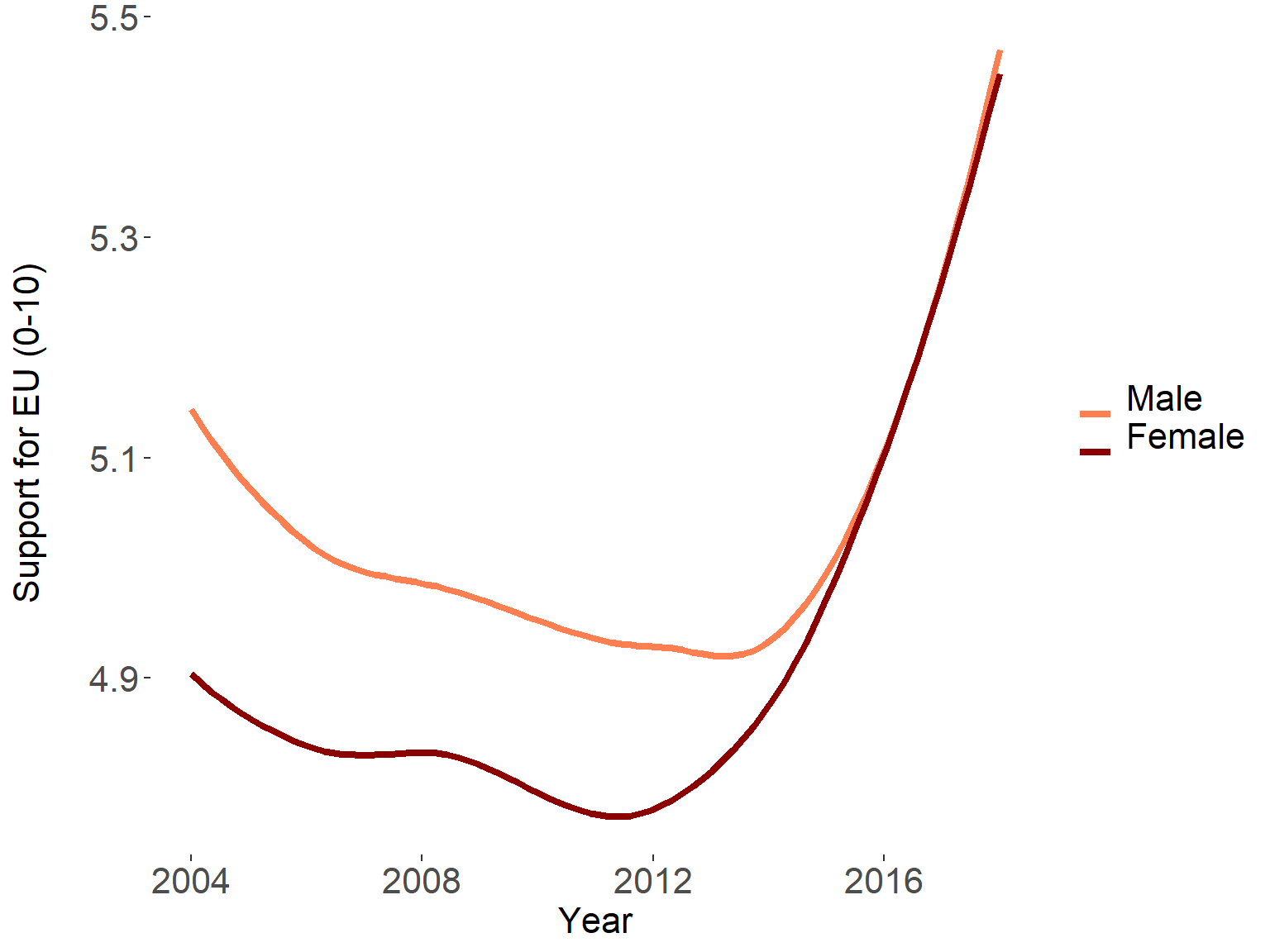
Gender Gap in Internationalism Over Time
Support for immigration
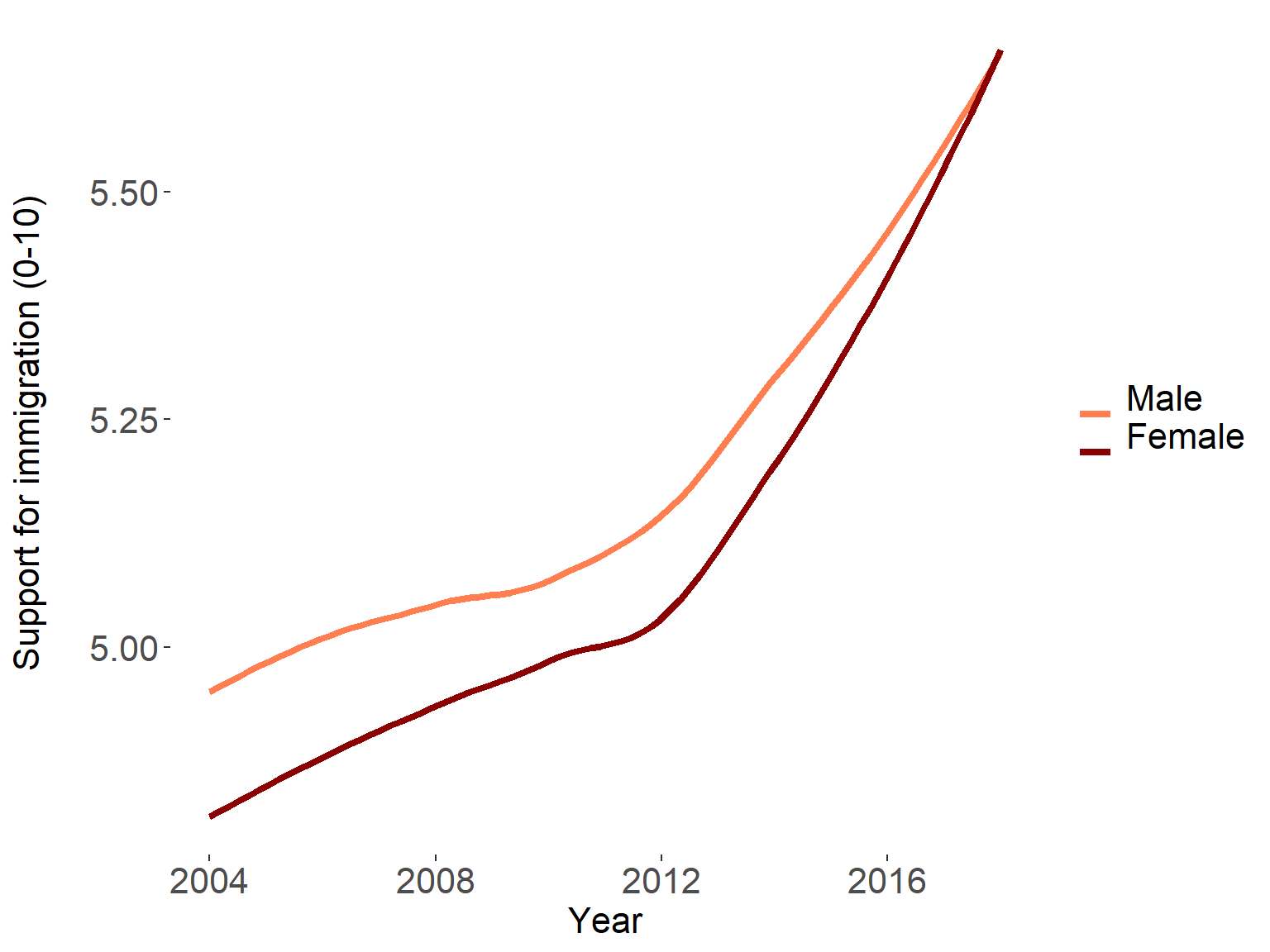
Gender Gap in Internationalism Over Time
Support for free trade
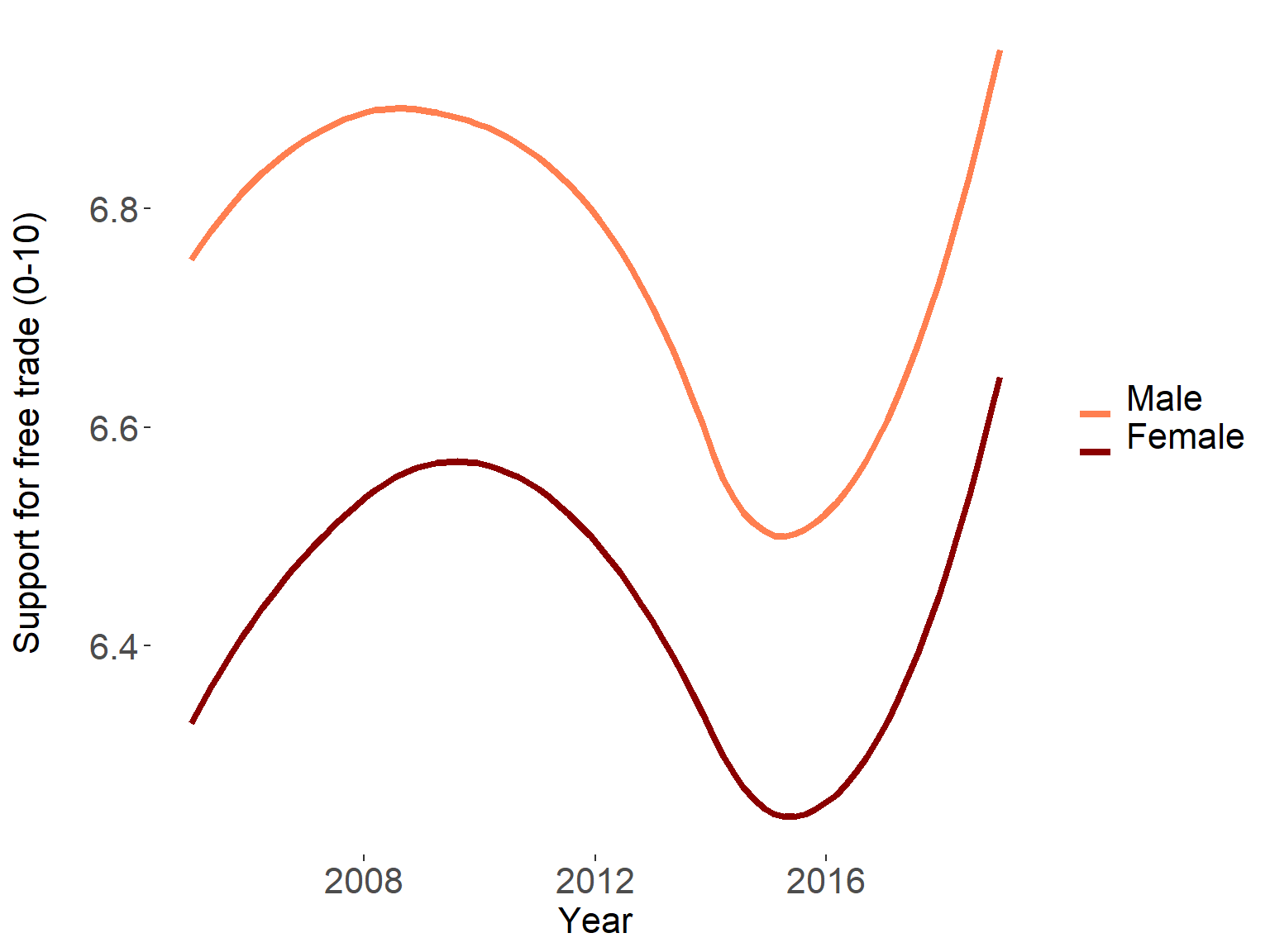
Why Is the Gender Gap in Internationalism Narrowing?
Narrowing of gender gap due to increased linking of anti-internationalism to right-wing extremism as populist radical right (PRR) becomes more prominent
Women react more strongly to linking of anti-internationalism with extremism than men → decreasing gender gap in internationalism
Why Is the Gender Gap in Internationalism Narrowing?
Narrowing of gender gap due to increased linking of anti-internationalism to right-wing extremism as populist radical right (PRR) becomes more prominent
Women react more strongly to linking of anti-internationalism with extremism than men → decreasing gender gap in internationalism
Why Is the Gender Gap in Internationalism Narrowing?
Narrowing of gender gap due to increased linking of anti-internationalism to right-wing extremism as populist radical right (PRR) becomes more prominent
Women react more strongly to linking of anti-internationalism with extremism than men → decreasing gender gap in internationalism
Evidence
Cross-national media and survey analysis in 8 Western European countries from 2000 to 2019
Unexpected event during survey design to estimate effect of Cox’s murder on support for internationalism by gender
Survey experiment in France to test potential mechanism
Evidence
Cross-national media and survey analysis in 8 Western European countries from 2000 to 2019
Unexpected event during survey design to estimate effect of Cox’s murder on support for internationalism by gender
Survey experiment in France to test potential mechanism
Evidence
Cross-national media and survey analysis in 8 Western European countries from 2000 to 2019
Unexpected event during survey design to estimate effect of Cox’s murder on support for internationalism by gender
Survey experiment in France to test potential mechanism
Why Is This Important?
Improve our understanding of factors that shape public opinion on internationalism
Changing relationship between gender and PRR parties
Why Is This Important?
Improve our understanding of factors that shape public opinion on internationalism
Changing relationship between gender and PRR parties
Traditional Gender Gap in Support for International Economic Integration
International trade (Guisinger 2009; Mansfield and Mutz 2009; Mayda and Rodrik 2005; Scheve and Slaughter 2001)
European integration (Gabel 1998; Liebert 1999; Nelsen and Guth 2000), but recent reversal (Boomgarden et al. 2011; De Vries 2018)
(Some types of) immigration (O’Rourke and Sinnott 2006; Ponce 2017)
Traditional Gender Gap in Support for International Economic Integration
International trade (Guisinger 2009; Mansfield and Mutz 2009; Mayda and Rodrik 2005; Scheve and Slaughter 2001)
European integration (Gabel 1998; Liebert 1999; Nelsen and Guth 2000), but recent reversal (Boomgarden et al. 2011; De Vries 2018)
(Some types of) immigration (O’Rourke and Sinnott 2006; Ponce 2017)
Traditional Gender Gap in Support for International Economic Integration
International trade (Guisinger 2009; Mansfield and Mutz 2009; Mayda and Rodrik 2005; Scheve and Slaughter 2001)
European integration (Gabel 1998; Liebert 1999; Nelsen and Guth 2000), but recent reversal (Boomgarden et al. 2011; De Vries 2018)
(Some types of) immigration (O’Rourke and Sinnott 2006; Ponce 2017)
Existing Explanations for Gender Gap
- International trade: concern about economic volatility (Guisinger 2017); trade as competition (Mutz 2021)
EU: Lack of knowledge (Nelsen and Guth 2000); responsiveness to gender mainstreaming (De Vries 2018)
Immigration: Threat to gender equality (Ponce 2017)
Existing Explanations for Gender Gap
International trade: concern about economic volatility (Guisinger 2017); trade as competition (Mutz 2021)
EU: Lack of knowledge (Nelsen and Guth 2000); responsiveness to gender mainstreaming (De Vries 2018)
Immigration: Threat to gender equality (Ponce 2017)
Existing Explanations for Gender Gap
International trade: concern about economic volatility (Guisinger 2017); trade as competition (Mutz 2021)
EU: Lack of knowledge (Nelsen and Guth 2000); responsiveness to gender mainstreaming (De Vries 2018)
Immigration: Threat to gender equality (Ponce 2017)
Existing Explanations for Gender Gap
International trade: concern about economic volatility (Guisinger 2017); trade as competition (Mutz 2021)
EU: Lack of knowledge (Nelsen and Guth 2000); responsiveness to gender mainstreaming (De Vries 2018)
Immigration: Threat to gender equality (Ponce 2017)
Argument
Differential reaction by gender to linking of anti-internationalism to right-wing extremism as PRR parties become more prominent
🡻
Narrowing of the gender gap on internationalism
Argument
Rising prominence of PRR parties in Western Europe → change in public discourse around anti-internationalism
→ PRR parties focus on anti-internationalism as challenger issue (De Vries and Hobolt 2020)
→ But much attention also paid to PRR parties’ tendencies toward right-wing extremism
→ Linking of anti-internationalism to right-wing extremism in public discourse
Argument
Rising prominence of PRR parties in Western Europe → change in public discourse around anti-internationalism
→ PRR parties focus on anti-internationalism as challenger issue (De Vries and Hobolt 2020)
→ But much attention also paid to PRR parties’ tendencies toward right-wing extremism
→ Linking of anti-internationalism to right-wing extremism in public discourse
Argument
Rising prominence of PRR parties in Western Europe → change in public discourse around anti-internationalism
→ PRR parties focus on anti-internationalism as challenger issue (De Vries and Hobolt 2020)
→ But much attention also paid to PRR parties’ tendencies toward right-wing extremism
→ Linking of anti-internationalism to right-wing extremism in public discourse
Argument
Rising prominence of PRR parties in Western Europe → change in public discourse around anti-internationalism
→ PRR parties focus on anti-internationalism as challenger issue (De Vries and Hobolt 2020)
→ But much attention also paid to PRR parties’ tendencies toward right-wing extremism
→ Linking of anti-internationalism to right-wing extremism in public discourse
→ Shift toward internationalism among those who reject right-wing extremism
Argument
Rising prominence of PRR parties in Western Europe → change in public discourse around anti-internationalism
→ PRR parties focus on anti-internationalism as challenger issue (De Vries and Hobolt 2020)
→ But much attention also paid to PRR parties’ tendencies toward right-wing extremism
→ Linking of anti-internationalism to right-wing extremism in public discourse
→ Shift toward internationalism among those who reject right-wing extremism
Argument
Role of gender
Women are on average more conscious of social norms and value them more (Ratcliff et al. 2006; Zhang et al. 2018)
Women are on average less comfortable with political extremism (Golebiowska 1999)
Argument
Role of gender
Women are on average more conscious of social norms and value them more (Ratcliff et al. 2006; Zhang et al. 2018)
Women are on average less comfortable with political extremism (Golebiowska 1999)
Argument
Change in discourse linking anti-internationalism to right-wing extremism
🡻
Internationalism increases more strongly among women than men
🡻
Narrowing of the gender gap
Argument
Change in discourse linking anti-internationalism to right-wing extremism
🡻
Internationalism increases more strongly among women than men
🡻
Narrowing of the gender gap
Hypotheses
H1: The effect of closer links between anti-internationalism and right-wing extremism in public discourse on support for internationalism will be stronger among women than among men.
H2: The moderating effect of gender on the relationship between changes in public discourse and support for internationalism will be stronger in countries where PRR parties are the primary political actors promoting anti-internationalism.
Hypotheses
H1: The effect of closer links between anti-internationalism and right-wing extremism in public discourse on support for internationalism will be stronger among women than among men.
H2: The moderating effect of gender on the relationship between changes in public discourse and support for internationalism will be stronger in countries where PRR parties are the primary political actors promoting anti-internationalism.
Study 1: Research Design
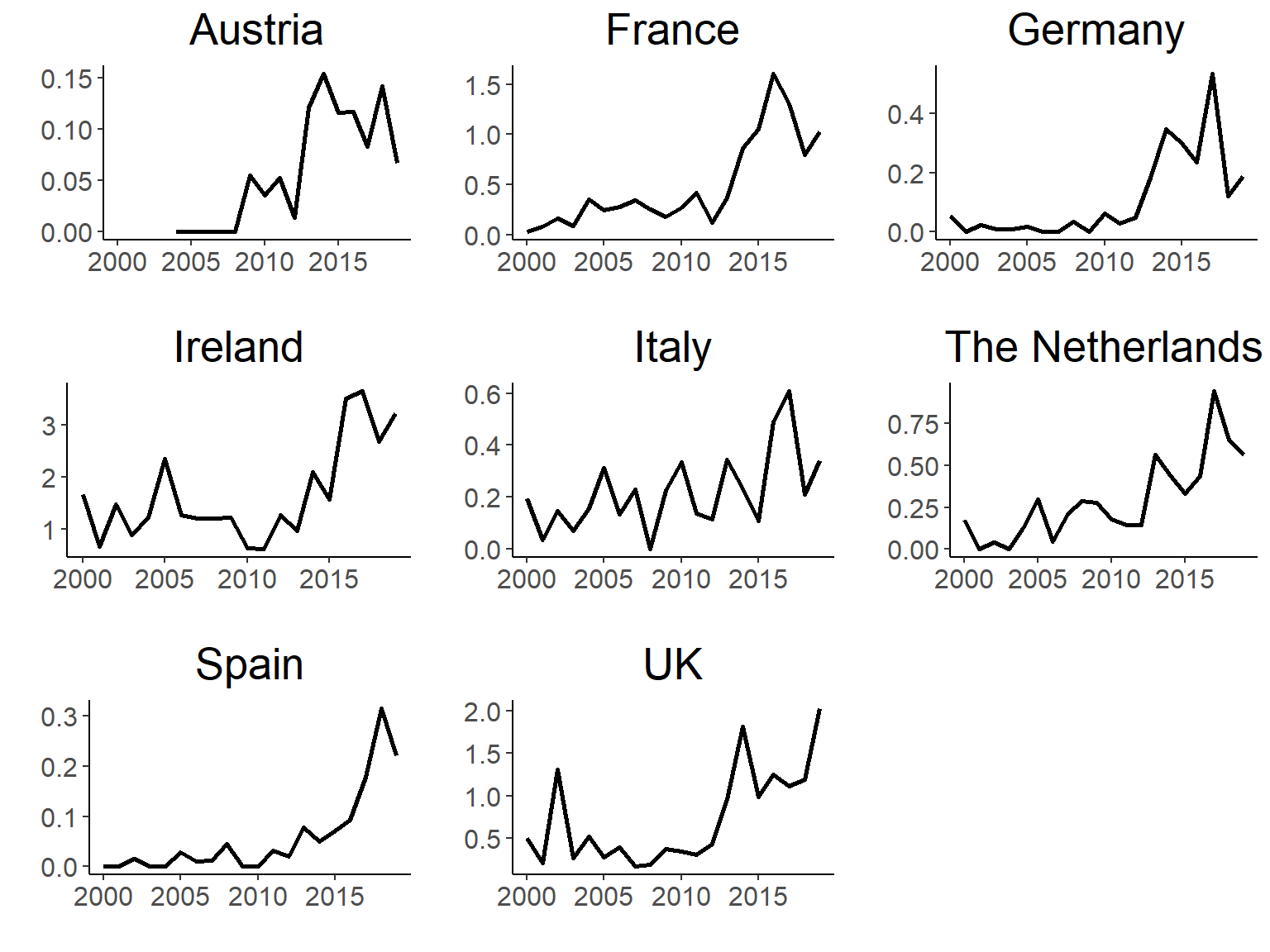
Measure of link between Euroskepticism and right-wing extremism in media discourse in 8 Western European countries (Austria, France, Germany, Ireland, Italy, the Netherlands, Spain, UK) from 2000 to 2019 (Obermeier 2021)
→ Manual coding of newspaper articles
Study 1: Research Design
“Vox is the Spanish version of the national populism we see in Europe … [Their] enemy includes the European Union, which is perceived as a danger to national interests … [I]n Vox’s political culture one can also find a positive assessment of the dictator Franco, and an image of World War II and the Civil War inherited from the Francoist version of history.” (Thomàs 2019)
Study 1: Research Design
Measure of link between Euroskepticism and right-wing extremism in media discourse in 8 Western European countries (Austria, France, Germany, Ireland, Italy, the Netherlands, Spain, UK) from 2000 to 2019 (Obermeier 2021)
→ Manual coding of newspaper articles
→ Supervised machine learning to classify remaining articles
→ Measure represents number of articles linking Euroskepticism to right-wing extremism divided by total number of articles about EU
Study 1: Resesarch Design
Merged Euroskepticism-extremism link measure with Eurobarometer survey data; support for EU as outcome variable
Individual level control variables: age, education, left-right self-placement
Country-year level control variables: unemployment rate, GDP growth, PRR party strength
Study 1: Resesarch Design
Merged Euroskepticism-extremism link measure with Eurobarometer survey data; support for EU as outcome variable
Individual level control variables: age, education, left-right self-placement
Country-year level control variables: unemployment rate, GDP growth, PRR party strength
Study 1: Resesarch Design
Merged Euroskepticism-extremism link measure with Eurobarometer survey data; support for EU as outcome variable
Individual level control variables: age, education, left-right self-placement
Country-year level control variables: unemployment rate, GDP growth, PRR party strength
Study 1: Results
Relationship between discourse and support for EU by gender

Study 2: Research Design
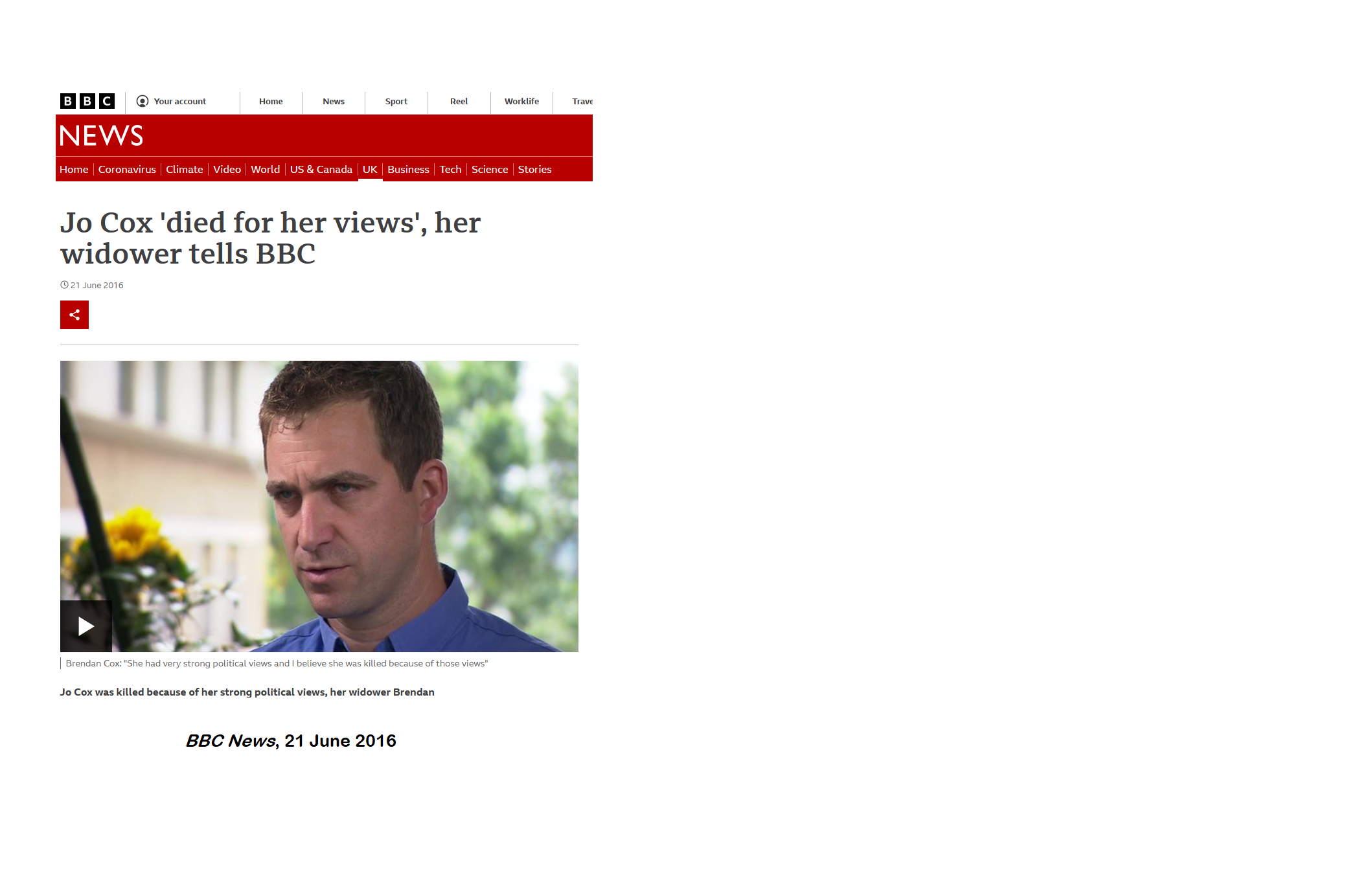
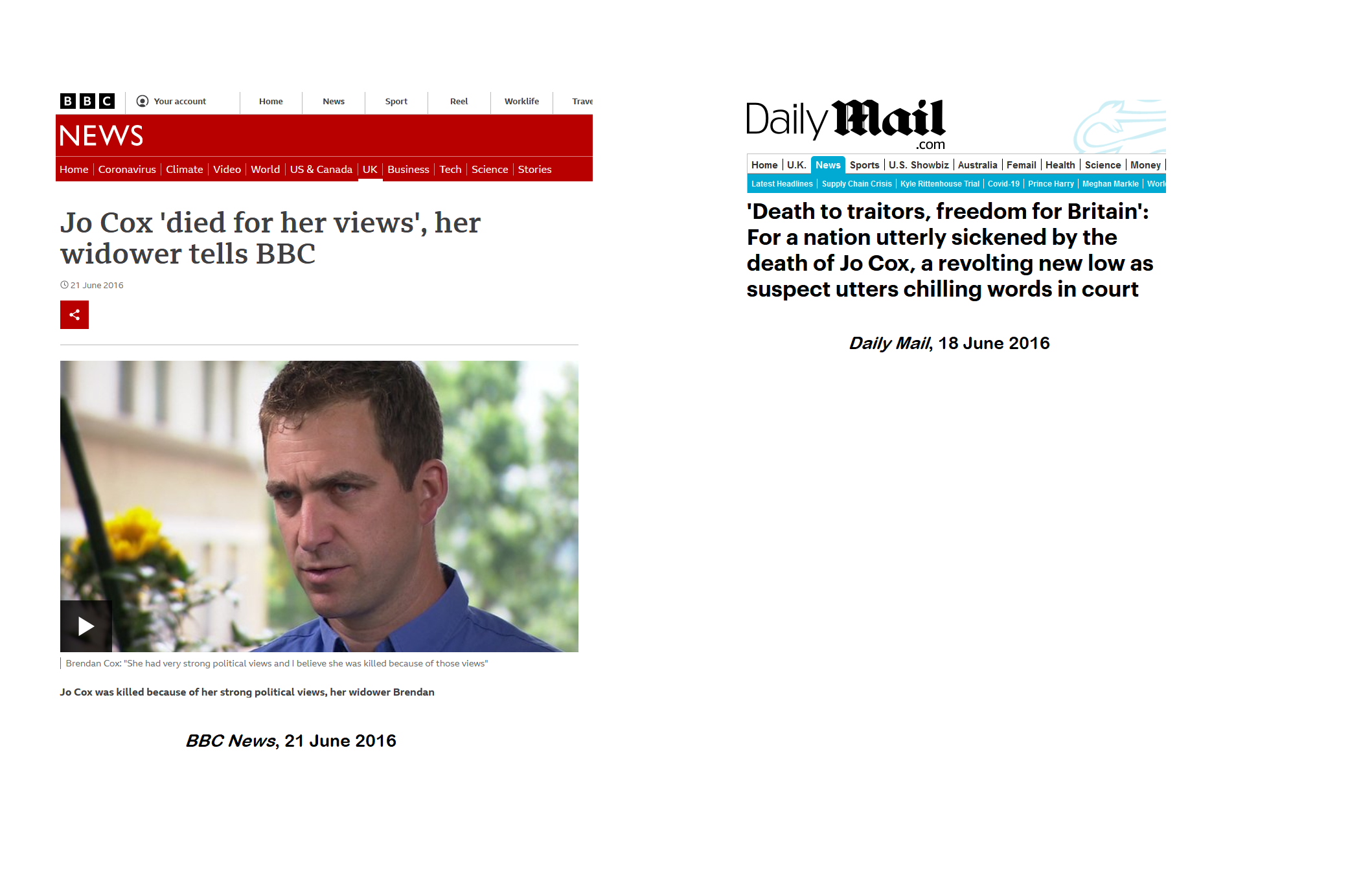
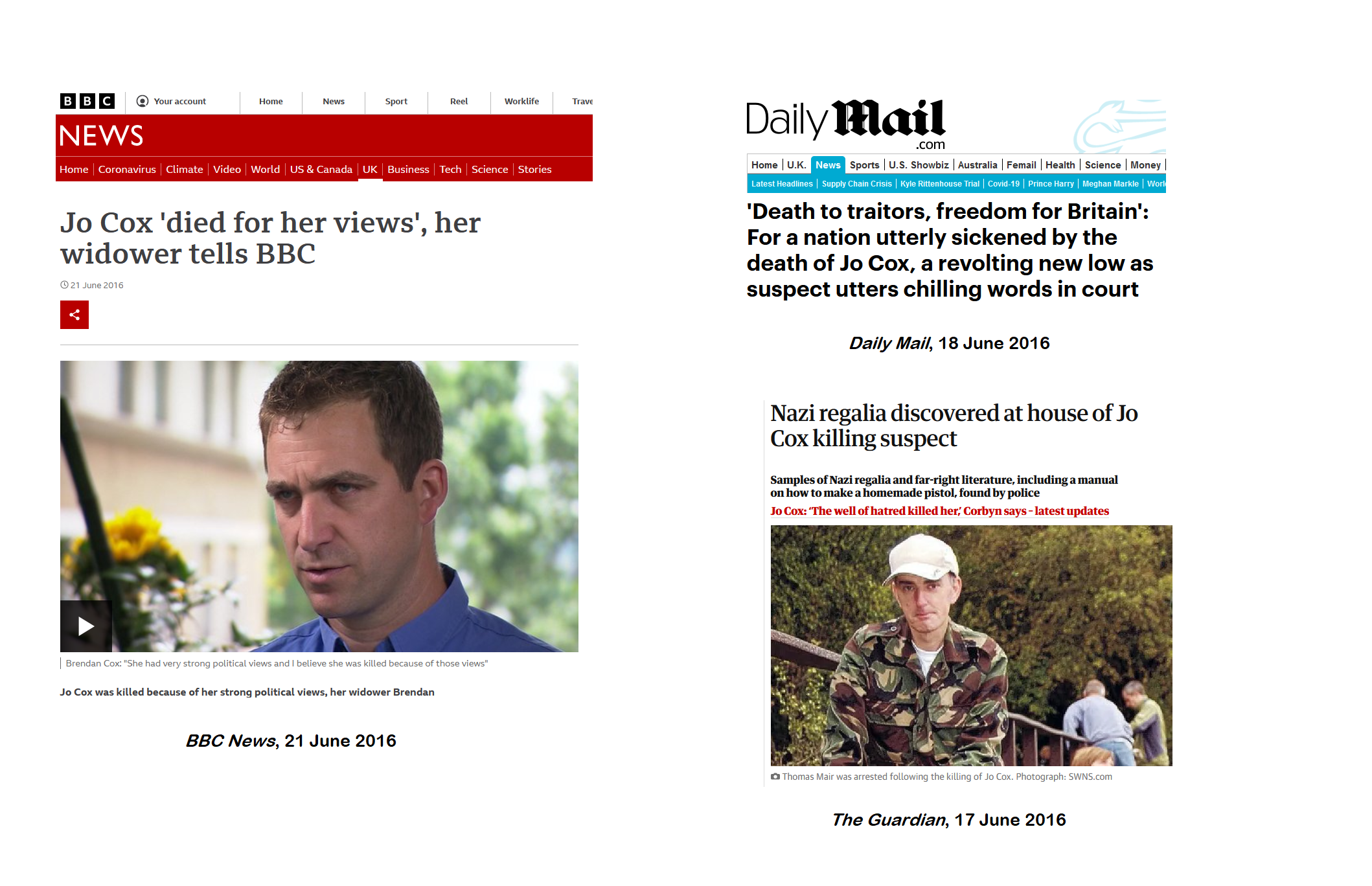
Unexpected event during survey design: murder of UK MP Jo Cox in June 2016
Unexpected shock that concentrated association between anti-internationalism and right-wing extremism in public discourse
Study 2: Research Design
Unexpected event during survey design: murder of UK MP Jo Cox in June 2016
Unexpected shock that concentrated association between anti-internationalism and right-wing extremism in public discourse
Study 2: Research Design
Study 2: Research Design
Study 2: Research Design
Study 2: Research Design
Unexpected event during survey design: murder of UK MP Jo Cox in June 2016
Unexpected shock that concentrated association between anti-internationalism and right-wing extremism in public discourse
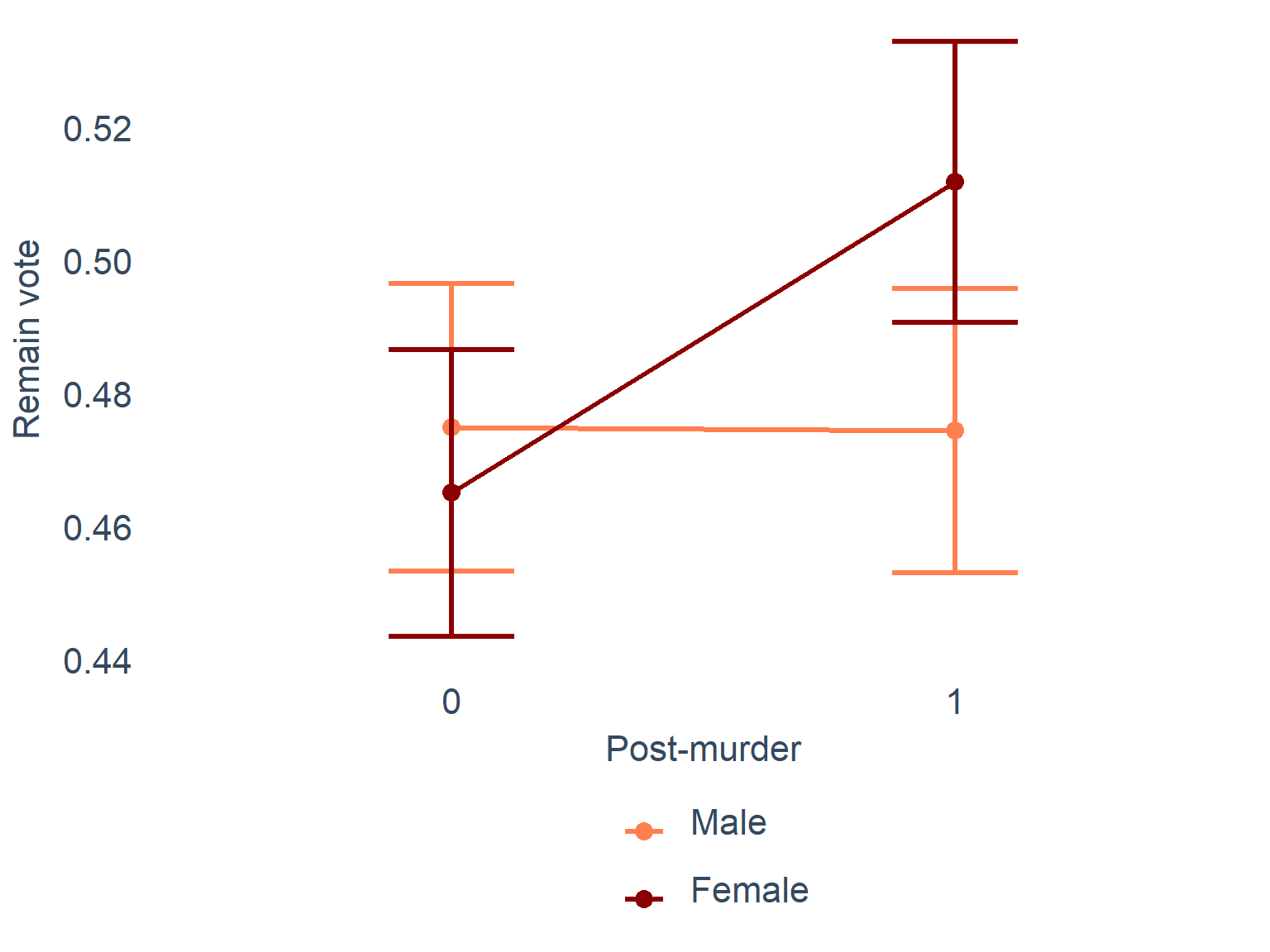
Timing of British Election Study (BES) allows me to compare responses collected immediately prior to the murder to those collected immediately afterwards, by gender
Regression of support for EU/support for immigration on interaction between pre-/post-murder and gender
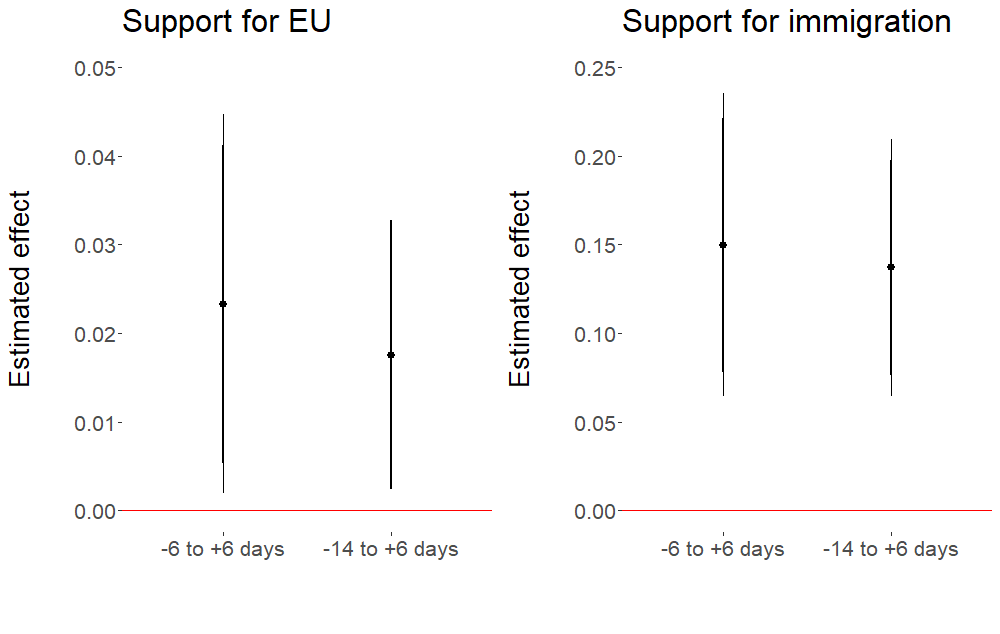
Bandwidth: 6 days pre- and post-murder
Study 2: Research Design
Unexpected event during survey design: murder of UK MP Jo Cox in June 2016
Unexpected shock that concentrated association between anti-internationalism and right-wing extremism in public discourse
Timing of British Election Study (BES) allows me to compare responses collected immediately prior to the murder to those collected immediately afterwards, by gender
Regression of support for EU/support for immigration on interaction between pre-/post-murder and gender
Bandwidth: 6 days pre- and post-murder
Study 2: Research Design
Unexpected event during survey design: murder of UK MP Jo Cox in June 2016
Unexpected shock that concentrated association between anti-internationalism and right-wing extremism in public discourse
Timing of British Election Study (BES) allows me to compare responses collected immediately prior to the murder to those collected immediately afterwards, by gender
Regression of support for EU/support for immigration on interaction between pre-/post-murder and gender
Bandwidth: 6 days pre- and post-murder
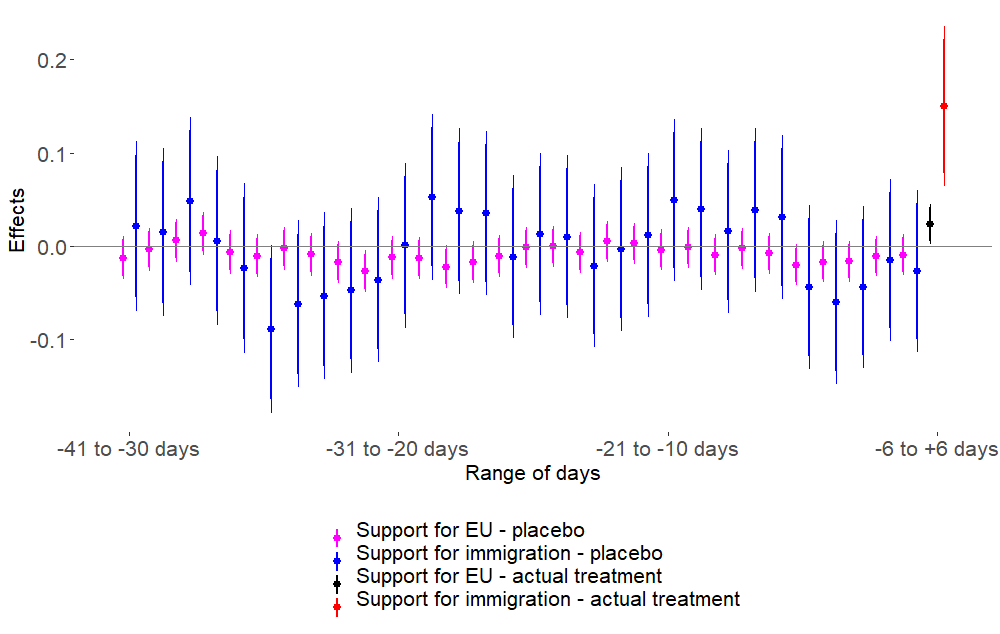
Study 2: Results
Effect of murder on intent to vote Remain by gender
Study 2: Results
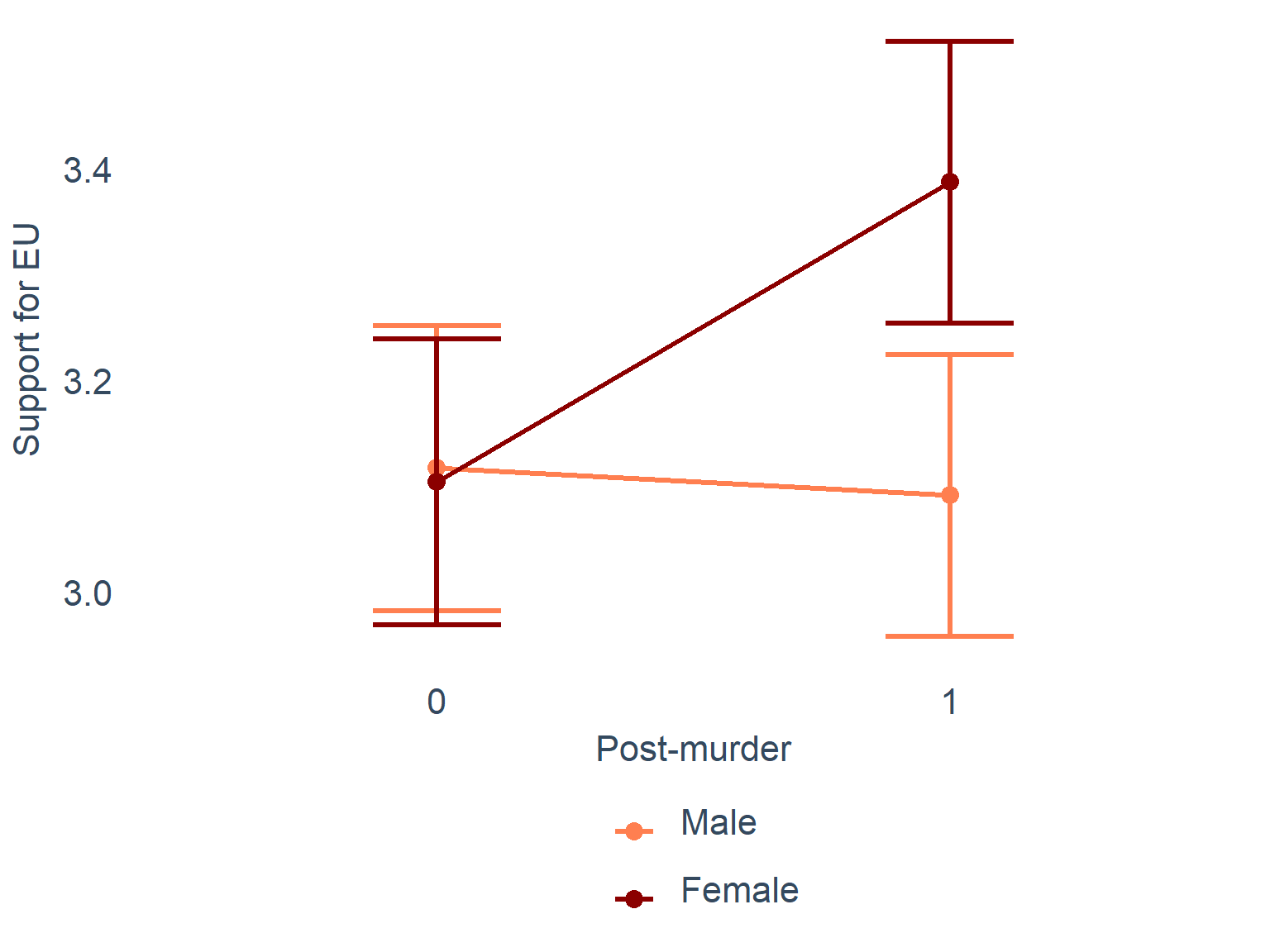
Effect of murder on support for EU by gender
Study 2: Results
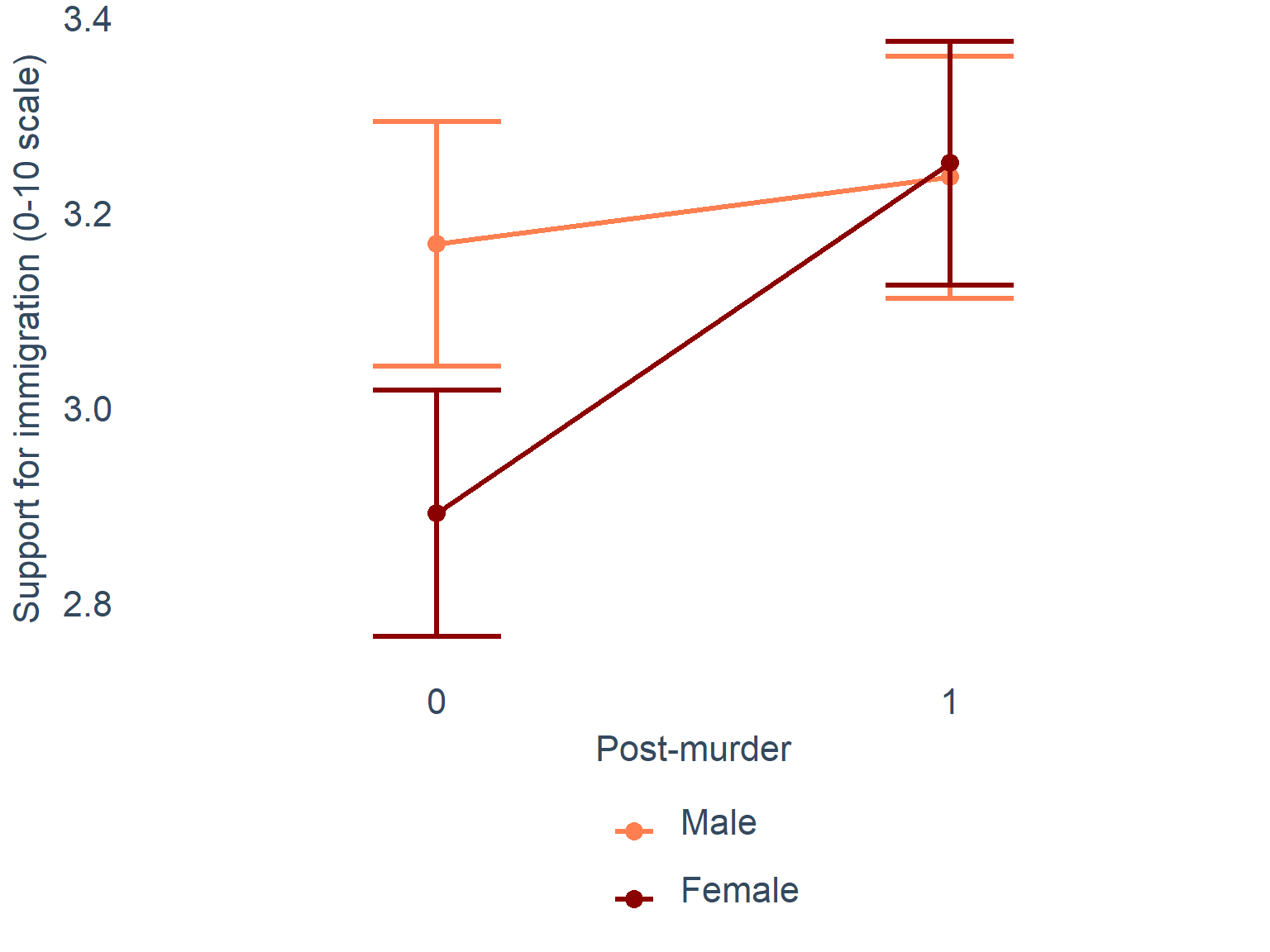
Effect of murder on support for immigration (admit more immigrants) by gender
Study 2: Results
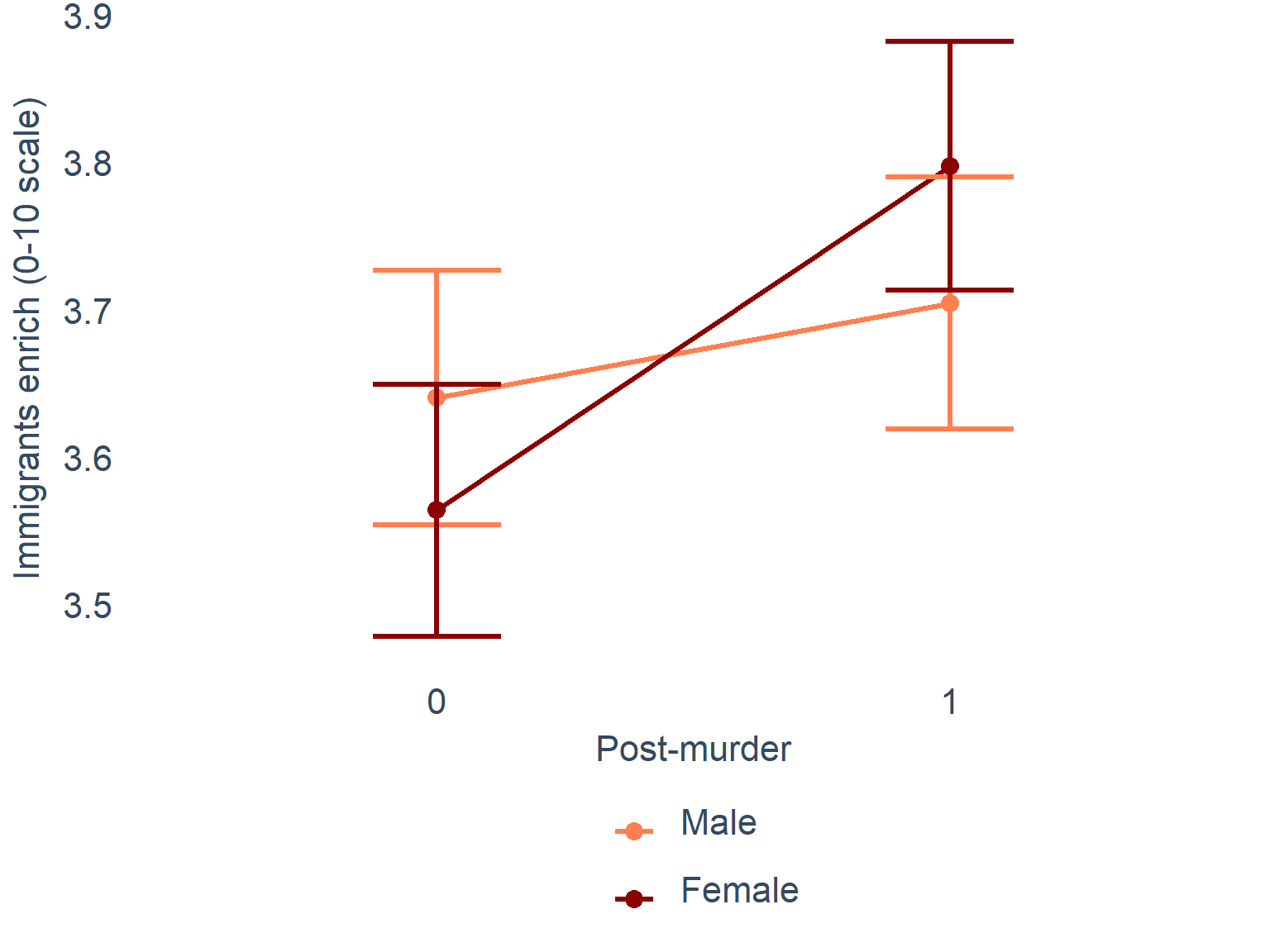
Effect of murder on support for immigration (immigrants enrich Britain’s cultural life) by gender
Study 2: Results
Effect of murder on support for immigration (immigration is good for Britain’s economy) by gender

Study 3: Research Design
- Posited mechanism: sensitivity to social norms
Survey experiment with 1,393 respondents in France in August 2023
Treatment: exposure to information about strength of social norm against racism
Study 3: Research Design
Posited mechanism: sensitivity to social norms
Survey experiment with 1,393 respondents in France in August 2023
Treatment: exposure to information about strength of social norm against racism
Study 3: Research Design
Posited mechanism: sensitivity to social norms
Survey experiment with 1,393 respondents in France in August 2023
Treatment: exposure to information about strength of social norm against racism
Study 3: Research Design
Posited mechanism: sensitivity to social norms
Survey experiment with 1,393 respondents in France in August 2023
Treatment: exposure to information about strength of social norm against racism
Study 3: Research Design
English translation of social norms treatment text:
More and more people in France consider racism to be unacceptable in today’s society. According to a recent survey, 93% of French people think denying a qualified Black or Maghrebin person a job is a serious offense. An overwhelming majority think the use of racial slurs should be condemned. Most people also think that it’s important to vigorously combat racism in France. Only 9% of French people believe some races are superior to others. Overall, France is becoming a country in which racism is increasingly seen as inappropriate.
Study 3: Research Design
Posited mechanism: sensitivity to social norms
Survey experiment with 1,393 respondents in France in August 2023
Treatment: exposure to information about strength of social norm against racism
Outcomes: support for immigration, EU, globalization, and free trade agreement
Control variables: age, gender, education, income, left-right self-placement
Study 3: Research Design
Posited mechanism: sensitivity to social norms
Survey experiment with 1,393 respondents in France in August 2023
Treatment: exposure to information about strength of social norm against racism
Outcomes: support for immigration, EU, globalization, and free trade agreement
Control variables: age, gender, education, income, left-right self-placement
Study 3: Results
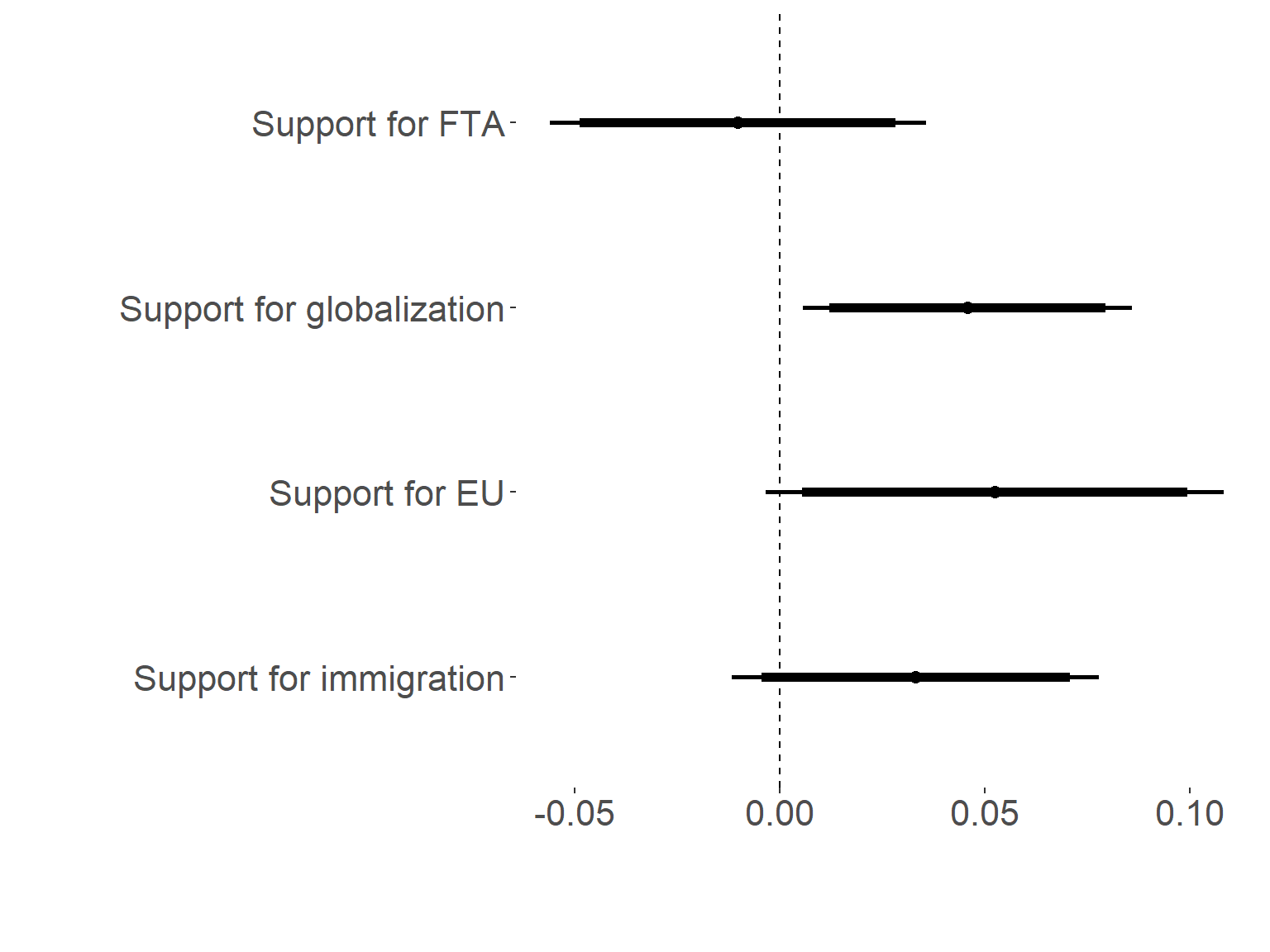
Effect of social norms treatment on internationalism
Conclusion
Gender gap in support for international integration narrowing in Western Europe
Driven by closer linking of anti-internationalism with extremism
Consciousness of social norms as potential mechanism
Conclusion
Gender gap in support for international integration narrowing in Western Europe
Driven by closer linking of anti-internationalism with extremism
Consciousness of social norms as potential mechanism
Conclusion
Gender gap in support for international integration narrowing in Western Europe
Driven by closer linking of anti-internationalism with extremism
Consciousness of social norms as potential mechanism
Implications
Discourse and social norms as important factors shaping attitudes toward internationalism
Importance of (changing) relationship between gender and the populist radical right
Implications
Discourse and social norms as important factors shaping attitudes toward internationalism
Importance of (changing) relationship between gender and the populist radical right
Implications
Thank you!
nina.obermeier@kcl.ac.uk
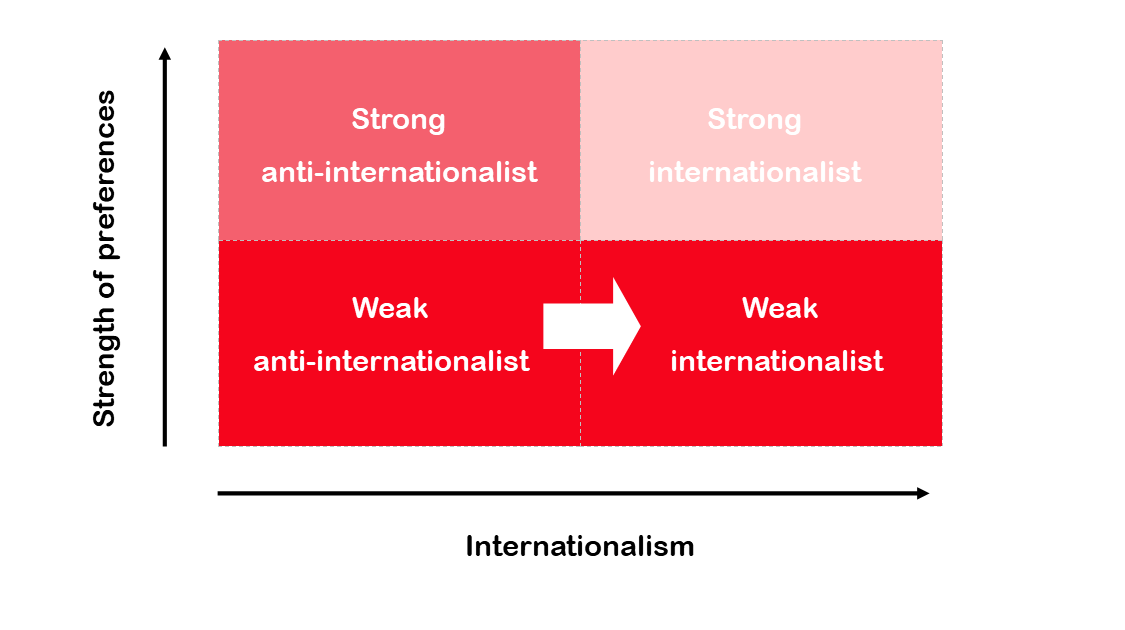
Asymmetric Strength of Preferences on Internationalism
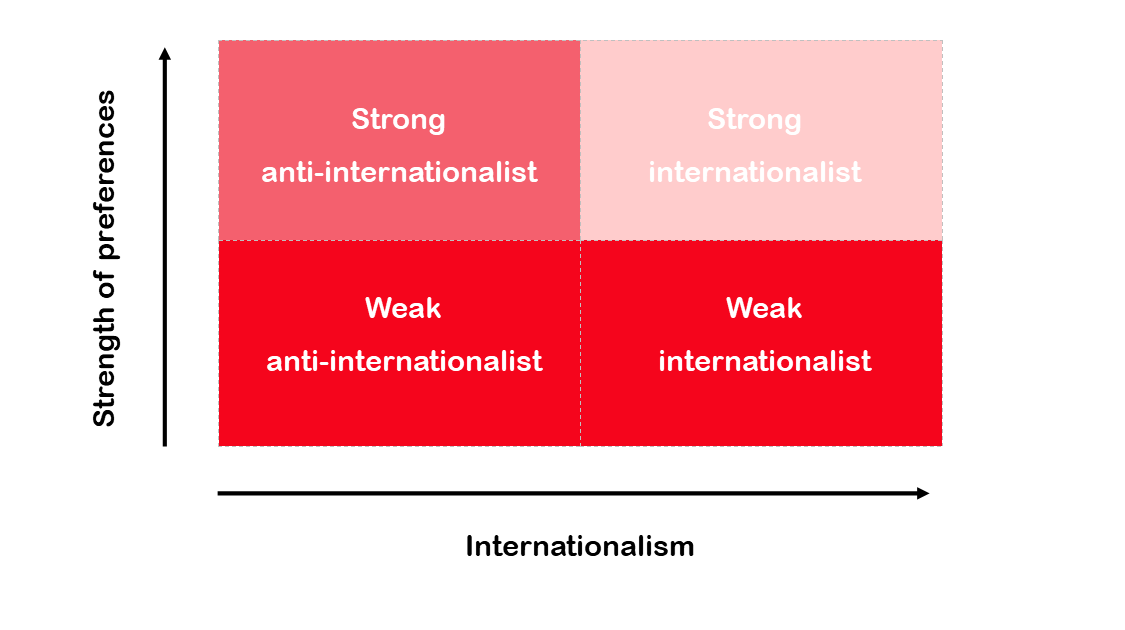
Asymmetric Strength of Preferences on Internationalism
Book Project: Results
Multilevel models: Support for European integration
| Model 1 | Model 2 | Model 3 | Model 4 | |
|---|---|---|---|---|
| Euroskepticism-extremism link | 0.055* | 0.027* | ||
| (0.003) | (0.004) | |||
| Euroskepticism-extremism link\(_{rolling}\) | 0.094* | 0.049* | ||
| (0.004) | (0.005) | |||
| Control variables | No | No | Yes | Yes |
| Observations | 303,206 | 303,206 | 229,674 | 229,674 |
| Countries | 8 | 8 | 8 | 8 |
| *p < 0.05 | ||||
Study 1: Research Design
Newspapers by country
| Newspaper 1 | Newspaper 2 | |
|---|---|---|
| Austria | Die Presse | Der Standard |
| France | Le Figaro | L’humanité |
| Germany | Die Welt | Süddeutsche Zeitung |
| Ireland | Irish Independent | Irish Times |
| Italy | Corriere della Sera | La Stampa |
| The Netherlands | Algemeen Dagblad | De Telegraaf |
| Spain | El Mundo | El País |
| UK | Daily Telegraph | Guardian |
Study 1: Research Design
Media analysis overview
| Articles | Hand-coded articles |
Precision | Recall | Balanced accuracy rate |
F-score | |
|---|---|---|---|---|---|---|
| Austria | 118,393 | 530 | 0.96 | 0.89 | 0.50 | 0.93 |
| France | 77,893 | 775 | 0.94 | 0.92 | 0.70 | 0.93 |
| Germany | 196,624 | 685 | 0.97 | 0.90 | 0.74 | 0.93 |
| Ireland | 139,637 | 930 | 0.84 | 0.90 | 0.70 | 0.87 |
| Italy | 87,706 | 715 | 0.97 | 0.91 | 0.72 | 0.94 |
| The Netherlands | 53,184 | 903 | 0.97 | 0.91 | 0.69 | 0.94 |
| Spain | 164,161 | 474 | 0.98 | 0.92 | 0.70 | 0.95 |
| UK | 166,390 | 492 | 0.94 | 0.94 | 0.72 | 0.94 |
Study 2: Results
Balance Tests: Study 2

Placebo-in-Time Analysis: Study 2